


BIW Line Design and Simulation: How Hinduja Tech Engineered a Collision-Free Underbody Main Line
by Nithyanand S.
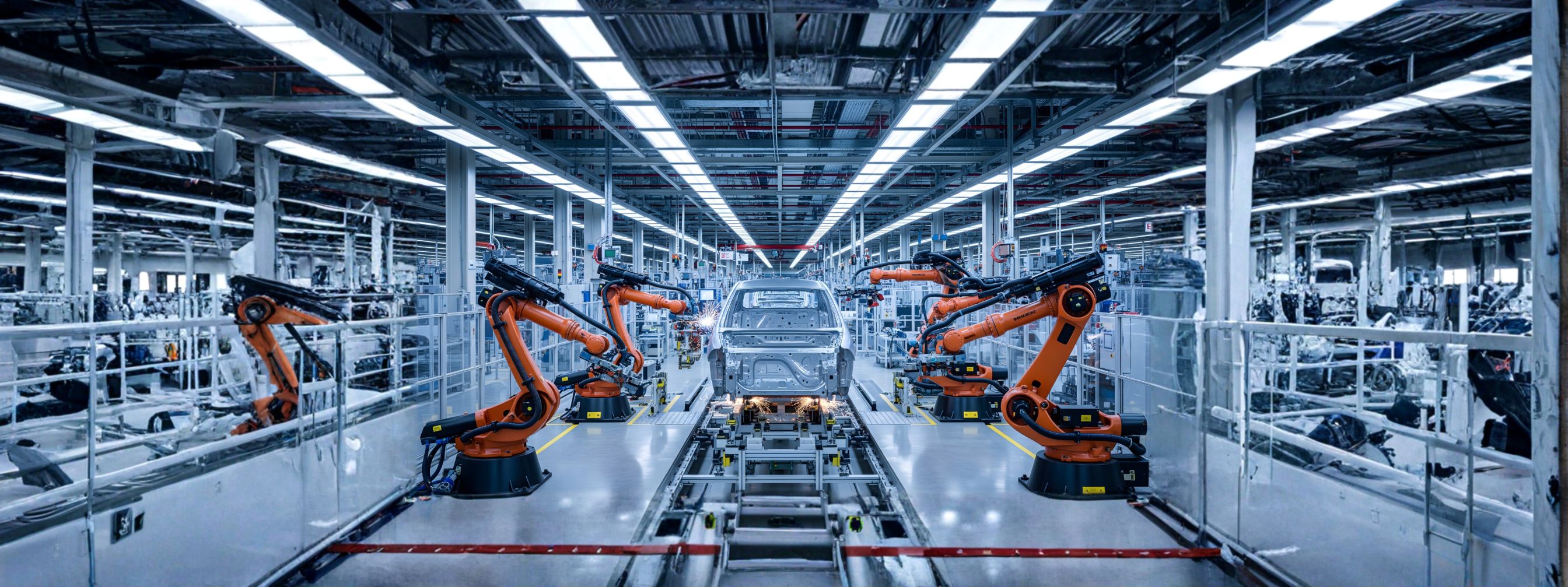
Body-in-White (BIW) line design is where automotive manufacturing programmes are won or lost. Every fixture position, every tool path, every robot sequence carries risk. And for an automotive OEM programme manager overseeing a full BIW line build, that risk does not announce itself during the design phase. It shows up at commissioning or production, when the cost of fixing it is at its highest.
This is the story of how Hinduja Tech delivered a fully validated, collision-free underbody main line for a leading passenger car manufacturer in the UK, and what rigorous BIW line design actually looks like in practice.
The Project Scope: End-to-End BIW Line Design
When a leading passenger car manufacturer in the UK needed its underbody main line built from the ground up, Hinduja Tech took ownership of the entire programme: from pre-engineering studies and simulations to offline programming and final validation.
The scope covered complete BIW line design, fixture and gripper engineering, manufacturing drawing generation, Bill of Materials (BOM) creation, and building a full 3D plant model, a digital replica of the plant environment constructed to reflect real-world conditions accurately.
The client provided clamping plans, part-loading sequences, spot details, weld-gun information, layout drawings, and a fixture standards library. From these, the team built a fully validated, production-ready line.
Our Approach: From Pre-Engineering to Full Line Validation
Pre-Engineering and Process Finalisation: Line requirements were studied in detail before any design work began. Process flow was finalised, and design risks were identified early, setting a reliable foundation for every step that followed.
Layout Optimisation: Station arrangement and line layout were optimised for throughput, access, and operator safety before detailed design began.
Concept 3D Design: Every fixture, gripper, trolley, and rack was modelled in 3D to reflect real-world geometry and movement, giving the client an accurate view of the line before drawings were produced.
2D Detailing and BOM: Manufacturing drawings and a complete Bill of Materials (BOM) were generated directly from the validated 3D model. Every drawing was traceable back to the 3D design, eliminating documentation discrepancies.
Cycle Time Preparation: Cycle times were calculated and verified against the client's production targets, confirming the line would meet output requirements from day one.
Offline Programming: Robot movements were programmed digitally within the simulation environment, removing the need for manual teach-in on the shop floor and reducing commissioning risk significantly.
BIW Line Simulation and Validation: A full simulation was run across the entire BIW line. Every robot path, tool movement, and clearance was validated digitally; collisions were checked, standard clearances were verified, and all sequences were confirmed to run without conflict.
What Was Delivered
The output was a fully validated, production-ready BIW Line, with zero collision surprises at commissioning:
- All tools were designed, validated, and functional without collisions
- All paths were free from collision with standard clearance maintained throughout
- Standard Operating Procedures (SOPs) were created with proper links and interlocks at every station
- Gun section documentation completed for final gun ordering
- Library folder structure maintained as per received standards
- Final 2D layout verified against the 3D model at every stage
- All operator safety measures were built into the design from the outset
The 3D plant model gave the client a complete digital twin: a single source of truth matching the physical reality of what would be built.
What This Means for the Future of Body-in-White Line Design
The Body-in-White line design does not fail at production. It fails earlier, where validation was skipped, a clearance was assumed, or a simulation step was cut to save time. And, as vehicle programmes accelerate and platform complexity grows, the margin for error narrows further.
Thus, simulation-first BIW line design, digital twins, and integrated documentation workflows are no longer differentiators across the automotive industry. They are becoming the baseline expectation, and the OEMs who recognise this are already demanding more rigour earlier in the engineering process.
This is precisely the standard Hinduja Tech holds for all our BIW line programmes. For this UK-based passenger car manufacturer, that meant a collision-free underbody main line, proven digitally, built right the first time, and delivered without surprises on the floor.
Ready to Engineer Your Next Collision-Free BIW Line?
Building a production-ready BIW line demands precision at every stage, and the cost of discovering a conflict at production far exceeds the investment of validating it at the design stage. At Hinduja Tech, we take complete ownership of every BIW line programme, from pre-engineering study through to full-line simulation and final validation, ensuring every line is delivered collision-free, production-ready, and built right the first time. Visit hindujatech.com to learn more.

About Author

Nithyanand S
Subscribe to Email Updates
FOLLOW US ON
LinkedIn @Hinduja Tech Limited
Categories
- Body Engineering (7)
- Digital Services (8)
- Electric & Future Mobility (10)
- Product Engineering Services (3)
- RelAI (1)
- SAP (3)
- Thermal Management (2)
- Commercial Vehicle (2)
- Industrial simulation (3)
- Supply chain engineering (1)
- Ergonomics (1)
- Human simulation (1)
- Automotive (4)
- Manufacturing (3)
- General (1)
- Sustainable (8)
- Engineering (13)
- Innovation (2)
- Electronics (1)
- CAE (7)
- Digital Technology (1)
- Supply Chain Management (4)
- vehicle electronics & software (6)
- vehicle engineering (2)
- Mobility (5)