


Defeating Solar Loading: How Hinduja Tech’s Cabin Thermal Simulation Ensured Passenger Comfort
by Jabastin Charles.
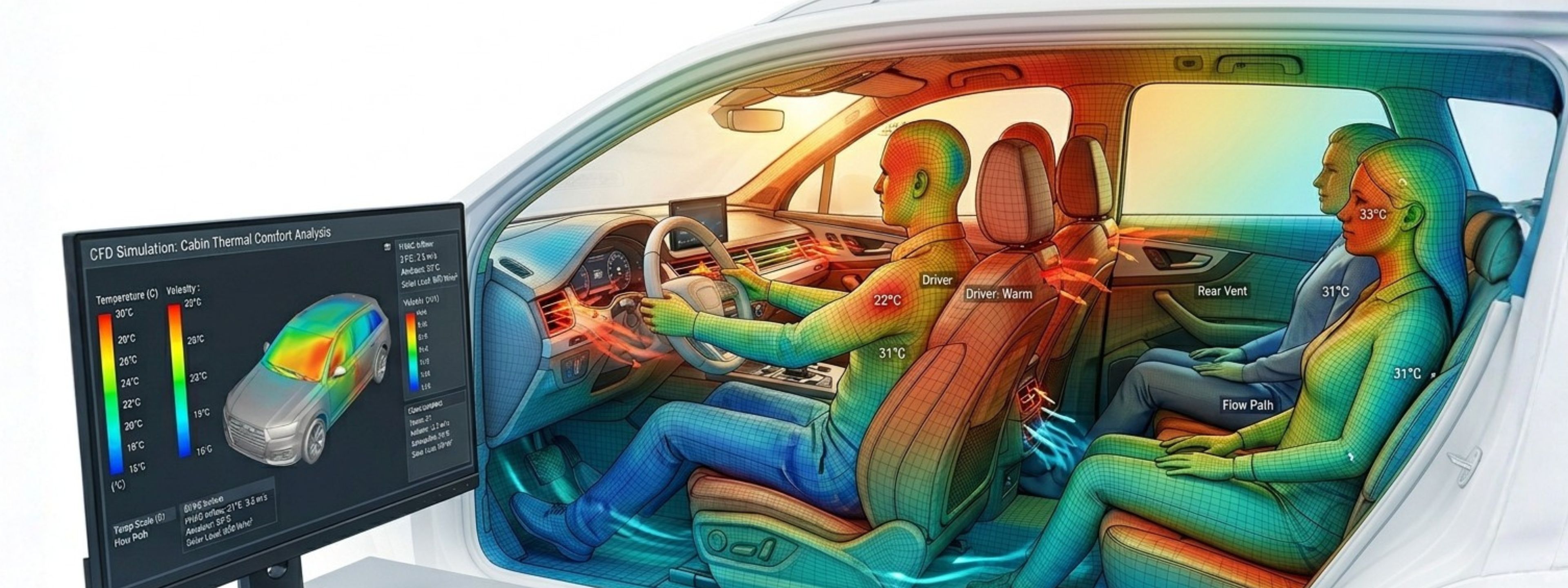
Step into a car that has been baking in the sun for an hour. The steering wheel burns. The seat is unbearable. Most people blame the weather. Engineers know the problem starts much earlier, in the design room, before the car is ever built.
That problem has a name: solar loading. And in today’s automotive landscape, particularly in electric vehicles, it is one of the most consequential yet underestimated challenges in automotive thermal management.
Why Automotive HVAC Design Cannot Be an Afterthought
Thermal comfort is not a luxury feature. It is a performance metric.
In combustion vehicles, an oversized HVAC system costs fuel. In electric vehicles, it costs range. Every watt used to cool a poorly managed cabin is a watt taken directly from the battery. For EV manufacturers competing on range figures and efficiency ratings, unoptimised vehicle thermal management is not just an inconvenience, it is a competitive liability. The stakes go further. A vehicle calibrated for temperate climates behaves very differently in South Asia, the Middle East, or sub-Saharan Africa, where solar intensity is far higher and ambient temperatures compound the challenge. For any global vehicle programme, solar loading simulation across geographic conditions is not optional. It is a market requirement.
And there is a passenger experience dimension that is just as important. The moment a customer opens a car door on a hot day, the brand makes a promise. A cabin that remains uncomfortable despite a running HVAC system is a product failure that no badge can overcome.
Project Scope: CFD-Led Evaluation of Cabin Thermal Dynamics
Our team was engaged to conduct a comprehensive automotive HVAC system study, specifically a CFD analysis of the AC duct and full cabin compartment geometry. The engagement addressed three critical questions that standard HVAC design often leaves unanswered:
- How do pressure, velocity, and airflow distribute through the AC duct system relative to actual passenger positions?
- How does solar heat loading change the cooling requirement as the sun angle and vehicle orientation shift through the day?
- What happens to cabin temperature when a door opens, and how does that thermal disruption propagate through the passenger zone?
The simulation toolchain comprised Ansys Fluent for CFD computations, SpaceClaim for geometry preparation, and CFD Post for results analysis, delivering high-fidelity thermal modelling across the entire cabin under multiple operating conditions.
The Challenges We Faced
Challenge 1: Surfaces, not just air The cabin air temperature was within an acceptable range under base conditions. But occupant discomfort persisted because surrounding surfaces, headliners, upper door panels, and seat backs had absorbed solar radiation and were radiating heat directly toward passengers. Cooling the air was not enough. The thermal environment of the occupant needed to be addressed at the source.
Challenge 2: Solar loading is not static A single simulation at peak solar angle gives an incomplete picture. The sun moves. The vehicle rotates relative to it. The cabin's thermal load changes continuously, and the HVAC system must respond to a condition that is never fixed. Capturing this required a transient simulation across multiple sun positions and orientations.
Challenge 3: Door-open events expose calibration gaps For many vehicle applications, particularly ride-share platforms, urban commuter buses, and high-frequency stop-start use cases, the cabin is not sealed during operation. Every door opening introduces a surge of warm ambient air into a zone that the HVAC was calibrated to manage as a closed system. Quantifying this disruption was essential to giving calibration engineers real data rather than assumptions.
The Solution We Delivered
Hinduja Tech structured the analysis around two parallel CFD scenarios: the existing duct geometry under standard operating conditions, and a revised vent configuration, with both scenarios run across three states: normal operation, peak solar load, and door-open events.
The thermal maps produced a clear and actionable picture. Under base conditions, the existing configuration cooled the cabin unevenly. Mid-cabin and head-height zones ran consistently warmer than air temperature alone would predict due to surface radiation from solar-heated panels. The air reaching occupants was cool. The radiant environment around them was not.
The revised vent configuration improved temperature distribution at head and nose-levels without changing HVAC capacity. It showed that open doors allow warm air to flood the lower passenger zone quickly, which the HVAC system, calibrated for a sealed environment, cannot keep up with. This finding guides the tuning of thermal response logic for vehicles with frequent entry and exit.
Results: What the Simulation Delivered
The project produced outcomes that went beyond thermal comfort optimisation:
- Transient solar loading fully characterised, enabling accurate HVAC sizing based on real thermal loads, eliminating the over-engineering that comes from conservative guesswork
- Target temperature values achieved at head and nose measurement points with the optimised vent configuration, with no increase in system capacity
- Door-opening thermal impact quantified with time-resolved data, giving calibration teams a real input for response tuning
- Cost reduction at the design stage, identifying and resolving thermal performance gaps in CFD, is significantly cheaper than discovering them in physical prototype testing
Specifically in the electric-vehicle thermal management context, the accurate HVAC sizing delivered by this study has direct implications for range. Removing the thermal waste inherent in a system designed for worst-case assumptions rather than the modelled reality reduces the parasitic load on the battery without compromising the customer's comfort.
Why Global OEMs Partner with Hinduja Tech
Thermal comfort should not get added at the end of a vehicle programme. It must be engineered in from the beginning, or it becomes an expensive, difficult-to-reverse problem that follows the vehicle through its commercial life.
By integrating high-fidelity CFD simulation into the earliest stages of the design cycle, Hinduja Tech enables global OEMs to predict, quantify, and mitigate solar loading and transient thermal disruptions long before the first physical prototype is built. We don't just solve the problem of a hot cabin; we protect your vehicle's range, optimize your component sizing, and safeguard your brand promise in the markets that matter most.
Engineering the Future of Cabin Comfort
Whether you are navigating the strict efficiency boundaries of a next-generation EV platform or calibrating a global vehicle architecture for extreme climates, your thermal strategy defines your product's success.
Don't let solar loading compromise your vehicle's range or passenger experience.
Partner with Hinduja Tech to leverage world-class CFD expertise, advanced thermal modeling toolchains, and deep automotive engineering heritage.
Reach out to us at info@hindujatech.com.

About Author

Jabastin Charles
Subscribe to Email Updates
FOLLOW US ON
LinkedIn @Hinduja Tech Limited
Categories
- Body Engineering (5)
- Digital Services (6)
- Electric & Future Mobility (10)
- Product Engineering Services (3)
- RelAI (1)
- SAP (1)
- Thermal Management (1)
- Commercial Vehicle (2)
- Industrial simulation (3)
- Supply chain engineering (1)
- Ergonomics (1)
- Human simulation (1)
- Automotive (3)
- Manufacturing (3)
- General (1)
- Sustainable (8)
- Engineering (13)
- Innovation (2)
- Electronics (1)
- CAE (6)
- Digital Technology (1)
- Supply Chain Management (4)
- vehicle electronics & software (4)
- vehicle engineering (0)
- Mobility (5)