


Driving the Future of EVs: Solving the Thermal Challenges of Battery Modules
by Jabastin Charles.

In the global push toward sustainable mobility, the transition to Electric Vehicles (EVs) is no longer a futuristic goal; it is a current operational reality. However, as manufacturers in automotive hubs strive for higher energy densities and faster charging cycles, they encounter a formidable hurdle: thermal management.
At Hinduja Tech, we see the battery module as the heart of this transition. But like any fit heart, it requires a perfectly regulated environment to function. The reality of battery engineering today is that performance and safety are inextricably linked to how well a team can predict and control heat.
The Invisible Barrier: Understanding Thermal Risks
For an OEM and a tier-1 supplier, the stakes of thermal mismanagement are high. When we look at the internal dynamics of a battery module, we aren't just looking at a single block of energy; we are looking at a complex city of individual cells, each generating its own heat.
Unmanaged thermal gradients, the difference in temperature between one cell and another, can lead to several critical failures:
- Accelerated Degradation: Cells operating at higher temperatures degrade significantly faster than their cooler counterparts, leading to an unbalanced module and a reduced overall lifespan.
- Performance limitations: Modern battery management systems (BMS) will "throttle" energy delivery or charging speeds if a single cell hits a thermal limit, resulting in suboptimal vehicle performance.
- Critical Safety Hazards: Localised hotspots increase the risk of thermal runaway, a catastrophic scenario every engineer works tirelessly to avoid. This self-sustaining chain reaction causes uncontrollable temperature spikes, potentially leading to vehicle fires, the release of toxic gases, and total battery failure.
- Financial & Brand Liability: Unforeseen thermal failures manifest as costly recalls and warranty claims that can erode consumer trust and a company’s bottom line.
The Challenge of Conventional Testing
Historically, the industry relied on a "build-and-break" cycle, constructing physical prototypes and subjecting them to rigorous thermal-chamber testing. While empirical data is essential, this approach is fraught with challenges. It is expensive, time-consuming, and often provides data only after a failure has occurred. Moreover, physical sensors can only be placed in so many locations, often missing the microscopic hotspots that develop deep within a module’s core.
The real challenge is to identify these risks during the design phase, long before a physical model is designed.
How Hinduja Tech’s CFD Team Can Solve Thermal Management Challenges in Battery Modules
Our approach at Hinduja Tech shifts the focus from reactive testing to proactive simulation. We utilise advanced Computational Fluid Dynamics (CFD) to unveil cell-level thermal dynamics with a level of granularity that physical testing alone cannot achieve.
Our methodology centres on creating a high-fidelity digital twin of the battery module. By using industry-leading tools such as Ansys Fluent, we simulate heat generation and dissipation across the entire module.
Granular Cell Analysis: We don't just look at the module's exterior; we focus specifically on temperature variations across individual cells to provide granular insights. Environmental Integration: Our models account for real-world variables, including gravity direction, air movement, and the influence of external heat sources. Hotspot Mapping: We generate precise temperature distribution plots that show engineers exactly where heat accumulates. Heat Balance Evaluation: We demonstrate the thermal characteristics of each cell, often modelling specific heat outputs to mirror actual operating conditions. Thermal Runaway: We incorporate a thermal abuse model to simulate thermal runaway in a selected single cell, including temperature propagation and gas venting within the battery pack. Busbar Electro Thermal: We predict the heat generation on the busbar/CCA due to the flow of peak current across the system.
Closing the Gap: The Importance of Correlation
A simulation is only as valuable as its accuracy. At Hinduja Tech, we take pride in rigorously validating our models against empirical data. In our recent case study, our simulation models achieved a correlation of over 95% with physical test results.
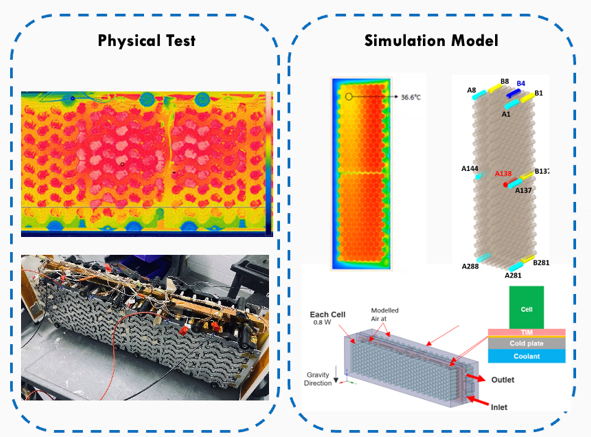
In a side-by-side comparison, the simulation accurately predicted the temperature distribution, aligning perfectly with the thermal patterns observed in physical prototypes. This level of precision allows our partners to build higher confidence in their digital models, significantly reducing the number of physical iterations required for B-Sample development.
Actionable Insights for Design Optimisation
The goal of our thermal analysis is to provide a roadmap for design improvement. We help our clients answer the "what-if" questions:
- What if we change the coolant flow rate?
- What if we change the coolant flow path?
- What if we change the charging/discharging rates?
- What if 1 cell goes to thermal runaway due to an internal short circuit?
- What if we adjust the material of the cold plate/enclosure/cell carrier?
- What is the necessary thermal conductivity of the thermal interface material (TIM)?
By identifying failure points proactively, we provide data-driven design optimisations that de-risk the entire development program.
Partnering for Safer, Smarter Mobility
As electrification continues to reshape the automotive landscape, the complexity of thermal management will only increase. Whether you are a startup looking to validate your first module or an established OEM refining a global platform, having a partner with deep automotive domain expertise is vital.
Hinduja Tech, a Hinduja Group company, combines decades of vehicle engineering expertise with cutting-edge digital simulation to deliver results that are both safe and production-ready.
Are you ready to reduce the risks involved in developing your EV battery?
Connect with our experts today and take the first step toward a more efficient, safer battery design.
Reach our global team at info@hindujatech.com to explore how our advanced CFD simulation expertise can accelerate your EV vehicle programs.

About Author

Jabastin Charles
Subscribe to Email Updates
FOLLOW US ON
LinkedIn @Hinduja Tech Limited
Categories
- Body Engineering (4)
- Digital Services (6)
- Electric & Future Mobility (10)
- Product Engineering Services (3)
- RelAI (1)
- SAP (1)
- Thermal Management (1)
- Commercial Vehicle (2)
- Industrial simulation (3)
- Supply chain engineering (1)
- Ergonomics (1)
- Human simulation (1)
- Automotive (3)
- Manufacturing (3)
- General (1)
- Sustainable (8)
- Engineering (13)
- Innovation (2)
- Electronics (1)
- CAE (5)
- Digital Technology (1)
- Supply Chain Management (2)
- vehicle electronics & software (3)
- vehicle engineering (0)
- Mobility (5)