


End-of-Life Vehicles: Engineering Solutions for Recycling and Reuse
by Admin.
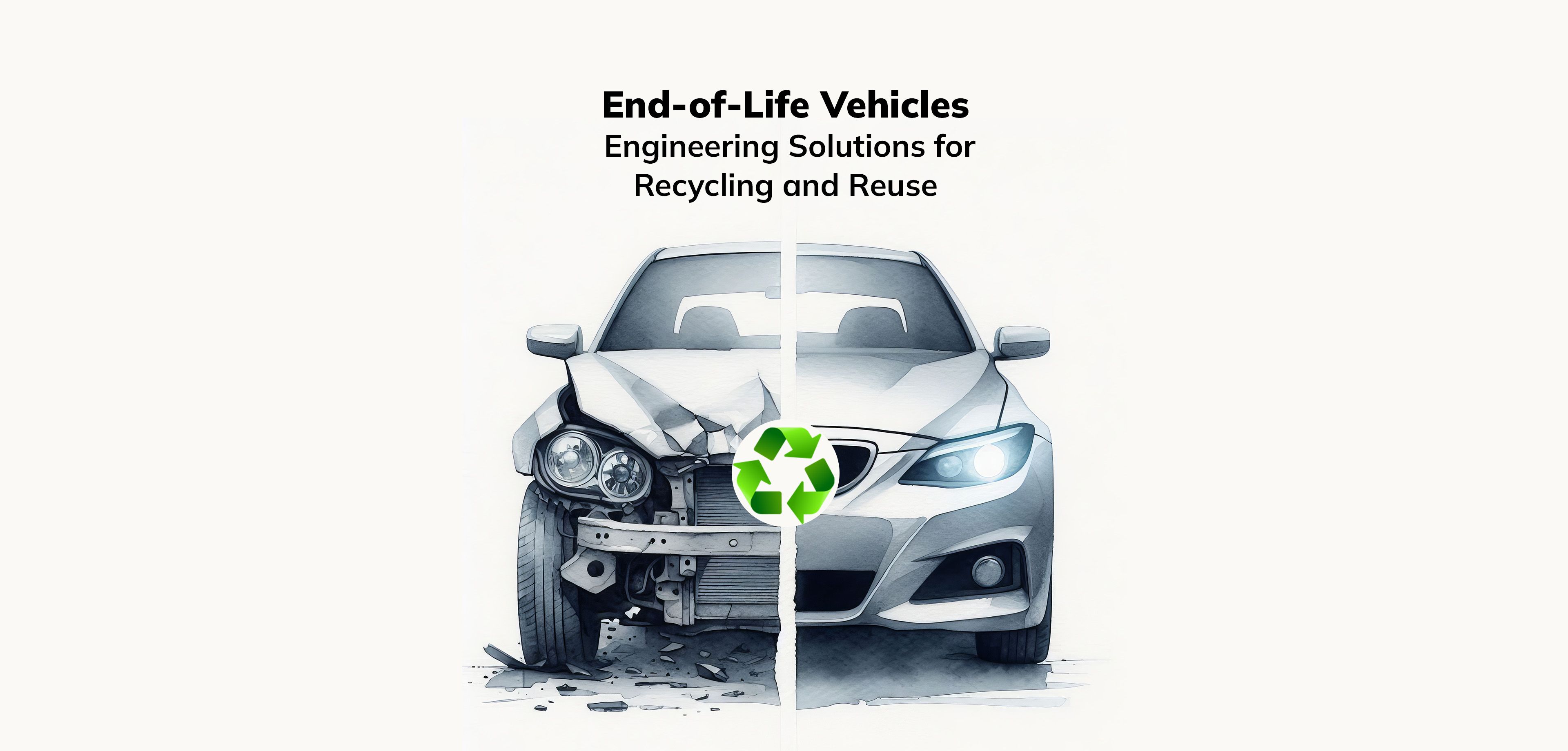
Every year, millions of vehicles reach the end of their operational life. In India alone, we're looking at approximately 1.5 million vehicles that are scrapped annually; a number that's only going to grow as our automotive market matures. But here's the thing: what we call "end-of-life" doesn't have to mean the end of value. In fact, it's quite the opposite.
Over the last two decades, the automotive industry's relationship with vehicle retirement has evolved dramatically. What was once a straightforward disposal problem has become one of the most exciting opportunities in sustainable mobility. And at Hinduja Tech, we're seeing firsthand how engineering innovation is turning end-of-life vehicles (ELVs) into strategic assets.
The Scale of the Challenge
Consider the following: a typical passenger vehicle contains roughly 30,000 parts made from over 1,000 different materials. We're talking about steel, aluminium, plastics, glass, rubber, precious metals, rare-earth elements, and, increasingly, lithium-ion batteries. When that vehicle reaches the end of its 12-15-year lifespan, all that material complexity doesn't just disappear; in fact, it becomes our responsibility.
Globally, ELVs generate approximately 25-30 million tonnes of waste annually. Without proper management, this results in significant environmental harm: toxic fluids leaching into soil, valuable materials sent to landfills, and enormous amounts of embodied energy wasted. The conventional approach, which includes crush, shred, and hope for the best, recovers maybe 75-80% of a vehicle's material value. We can do better. We must do better.
Engineering at the Intersection of Sustainability and Economics
The most compelling aspect of ELV management isn't just the environmental imperative; it's the convergence of sustainability with genuine economic opportunity. Modern engineering solutions are proving that circular economy principles aren't just good ethics; they're good business.
Consider material recovery. Today's advanced dismantling technologies can achieve recovery rates exceeding 95%. We're using AI-powered robotic systems that can identify and separate different grades of aluminium alloys with precision that manual processes could never match. These aren't incremental improvements; they're game-changers that make recycled materials genuinely competitive with virgin resources.
When you engineer with end-of-life in mind from day one, you fundamentally change the economics. Modular construction, standardized fastening systems, and material marking for automated sorting: these design choices made during product development can reduce dismantling time by 40-50% down the line.
The Battery Conundrum
And then there's the elephant in the room: electric vehicle batteries.
As EV adoption accelerates, we're facing a looming challenge. A lithium-ion battery that's no longer suitable for automotive use (typically when it retains about 70-80% of its original capacity) still has immense value. The question is: how do we capture it?
This is where engineering innovation becomes critical. It's developing sophisticated diagnostic systems that can assess battery health at the cell level, identifying which modules can be repurposed for second-life applications, for instance, energy storage systems for renewable integration, backup power solutions, and even grid stabilization. The batteries that are truly at end-of-life undergo advanced hydrometallurgical or direct recycling processes that can recover over 95% of valuable materials, such as lithium, cobalt, nickel, and manganese.
The engineering challenge isn't just technical; instead, it's systemic. We need traceability systems that track battery health throughout its first life, standardization that enables second-life integration, and automated disassembly systems that safely handle high-voltage components. These are precisely the kinds of complex, multi-disciplinary problems that get our engineering teams excited.
Creating Value Through Remanufacturing
Here's something that doesn't get enough attention in sustainability conversations: remanufacturing. Not recycling, not repairing, but true remanufacturing, where components are restored to original equipment manufacturer specifications and performance.
Think about it. A vehicle's engine, transmission, or electronic control unit might reach the end of its first life cycle, but with proper remanufacturing, these components can deliver 80-90% of their original service life at 50-60% of the cost of new parts. We're not talking about compromised quality; instead, properly remanufactured components often meet or exceed OEM specifications because the process identifies and eliminates the original design weaknesses.
The engineering that enables this is fascinating. Advanced metrology systems can measure wear at micron levels. Additive manufacturing enables us to rebuild worn surfaces with material properties superior to those of the original. Digital twins let us simulate component stress and predict remaining useful life with remarkable accuracy. What is most exciting is how this creates entirely new business models. OEMs can offer certified remanufactured components with warranties, creating customer value while reducing reliance on raw materials. It's a win-win that's only possible when engineering rigor meets circular economy thinking.
The Digital Backbone
None of this works without digital infrastructure. Modern ELV management is fundamentally a data problem, and that's where engineering is making perhaps its most significant contribution.
Implementing blockchain-based vehicle passports can help track materials from production through multiple use cycles. IoT sensors monitor vehicle health in real-time, enabling predictive maintenance that extends operational life and provides valuable data for end-of-life planning. Machine learning algorithms optimize dismantling sequences and predict the recoverable value of incoming vehicles.
When you can predict which vehicles will enter the recycling stream six months in advance, you can optimize logistics, pre-arrange buyers for recovered materials, and ensure that the right technical capabilities are available at the right time.
The Road Ahead
Current global ELV recycling rates hover around 85%, but achieving the circular economy vision of 95%+ recovery requires continued innovation. Battery recycling infrastructure is still nascent. Regulatory frameworks in many markets, including India, are evolving but remain incomplete. Consumer awareness of remanufactured components remains limited.
But the momentum is undeniable. The European Union's End-of-Life Vehicles Directive is driving standardization. India's vehicle scrapping policy is creating market pull. Most importantly, the economics are increasingly favourable as raw material prices rise and recycling technologies mature.
The automotive industry stands at a pivotal moment. The same engineering ingenuity that created the modern automobile can redesign it for a circular future. At Hinduja Tech, we're committed to being at the forefront of this transformation not because it's trendy, but because it's essential. The vehicles we engineer today will become tomorrow's material resources. That's not a constraint; it's an opportunity.
And it's one we're engineering our way toward, one innovation at a time.

About Author

Admin
Subscribe to Email Updates
FOLLOW US ON
LinkedIn @Hinduja Tech Limited
Categories
- Body Engineering (5)
- Digital Services (6)
- Electric & Future Mobility (10)
- Product Engineering Services (3)
- RelAI (1)
- SAP (1)
- Thermal Management (1)
- Commercial Vehicle (2)
- Industrial simulation (3)
- Supply chain engineering (1)
- Ergonomics (1)
- Human simulation (1)
- Automotive (3)
- Manufacturing (3)
- General (1)
- Sustainable (8)
- Engineering (13)
- Innovation (2)
- Electronics (1)
- CAE (6)
- Digital Technology (1)
- Supply Chain Management (4)
- vehicle electronics & software (5)
- vehicle engineering (0)
- Mobility (5)