


How Simulation-Led Design Solves the High-Stakes Challenges of Bus Electrification
by Mahendra Pardeshi.
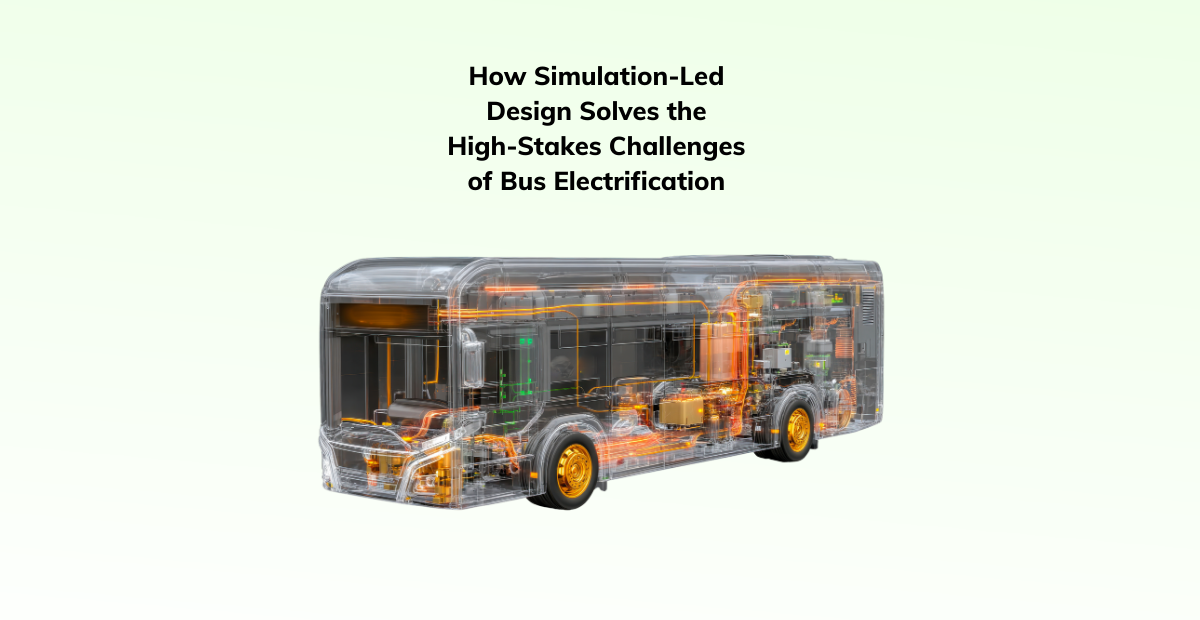
In the global race toward zero-emission transit, the transition from Internal Combustion Engines (ICE) to Electric Vehicles (EV) is frequently oversimplified. Industry outsiders often view it as a simple swap: removing a diesel engine and dropping in a battery pack. In reality, bus electrification requires a total architectural overhaul. Every modification creates a ripple effect that impacts structural integrity, axle load limits, and even passenger safety.
At Hinduja Tech, we resolve these challenges digitally first. By utilizing a virtual-first approach, we work out the hardest integration problems before building even begins. This simulation-led approach ensures that the move to a Battery Electric Vehicle (BEV) platform is not just an aspirational goal, but a predictable, high-performance reality.
Challenges Faced
Modern bus electrification involves balancing extreme weight constraints with safety-critical packaging. Hinduja Tech’s recent project illustrates the complexity of re-engineering a traditional chassis to house a high-voltage powertrain. With heavy battery modules, traction motors, and complex power electronics needing a home, the objectives were clear yet challenging:
1. The Complexity of Architectural Packaging
- Integrating high-volume components like traction motors and DC-DC converters without ruining the vehicle's center of gravity.
- Managing the risk of dangerous handling and premature tire wear caused by improper weight distribution.
- Optimizing axle load ratings to prevent structural failure or regulatory non-compliance.
2. Navigating the "Belly Scrap" (Ramp Over Angle)
- Protecting battery packs tucked under the floor from road impact during navigation of steep hills or speed bumps.
- Managing the risk of "belly scraping," which presents a severe safety hazard for high-voltage systems.
- Balancing the need for battery protection with the low floor height requirements for passenger accessibility.
3. Thermal Management and Safety Systems
- Dissipating massive amounts of heat generated during rapid charging and long city shifts to prevent battery life degradation.
- Meeting rigorous IP (Ingress Protection) ratings to protect high-voltage systems from dust and water.
- Integrating Fire Detection and Suppression Systems (FDSS) to mitigate the risk of catastrophic system failure.
Our Approach
Hinduja Tech utilizes Virtual Validation and Digital Mock-Up (DMU) tools to model, test, and refine vehicle architecture before a single prototype is built. By front-loading the engineering process, we assess the impact of every component on vehicle performance, avoiding costly "trial and error" during physical manufacturing. The simulation-driven methodology involved:
- Structural Validation: Using Finite Element Analysis (FEA) and LS-Dyna to verify battery mountings and chassis integrity, ensuring stability under all load conditions.
- Space Management: Applying 3D Packaging to map traction motors and electronics, eliminating component interference while maximizing cabin space.
- Thermal Optimization: Utilizing Computational Fluid Dynamics (CFD) to simulate heat dissipation and coolant flow, guaranteeing battery health even during peak operating cycles.
- Regulatory Alignment: Modeling AIS 052 compliance and propeller shaft angles to secure ground clearance and ensure smooth, vibration-free power delivery.
The Results By bridging the gap between virtual validation and physical reality, we delivered a road-ready architecture. The simulation-led insights provided the OEM with a blueprint that prioritized both vehicle longevity and passenger safety.
- Optimized Axle Load & Handling: Achieved a balanced center of gravity, significantly improving steering response and reducing uneven tire wear.
- Guaranteed Regulatory Compliance: Confirmed that ground clearance and floor height met all AIS 052 standards, ensuring passenger safety and accessibility.
- Cost & Risk Mitigation: Validated fire safety (FDSS) and thermal paths virtually, eliminating the need for expensive, late-stage physical modifications.
- Seamless Driveline Integration: Resolved potential vibrations by optimizing propeller shaft angles, ensuring smooth and reliable power delivery.
Why OEMs Partner with Us
This case study exemplifies Hinduja Tech’s commitment to next-generation mobility engineering. By managing complex driveline variables, such as propeller shaft angles and lengths virtually, we eliminate safety-critical errors and expensive physical prototypes early in the development cycle. Beyond technical expertise, our virtual-first strategy provides a decisive strategic advantage: optimized development costs and accelerated production schedules.
By delivering certainty at every milestone, from initial concept to final launch, we provide our partners with the competitive edge and predictable success needed to lead in the rapidly evolving e-mobility industry.
Engineer Your Future with Hinduja Tech
Accelerate your e-mobility roadmap with a partner that turns engineering complexity into predictable success. Let our simulation-led approach optimize your development costs and bring your EV platform to market faster.
Contact us today at info@hindujatech.com.

About Author

Mahendra Pardeshi
Subscribe to Email Updates
FOLLOW US ON
LinkedIn @Hinduja Tech Limited
Categories
- Body Engineering (4)
- Digital Services (6)
- Electric & Future Mobility (10)
- Product Engineering Services (3)
- RelAI (1)
- SAP (1)
- Thermal Management (1)
- Commercial Vehicle (2)
- Industrial simulation (3)
- Supply chain engineering (1)
- Ergonomics (1)
- Human simulation (1)
- Automotive (3)
- Manufacturing (3)
- General (1)
- Sustainable (8)
- Engineering (13)
- Innovation (2)
- Electronics (1)
- CAE (6)
- Digital Technology (1)
- Supply Chain Management (2)
- vehicle electronics & software (3)
- vehicle engineering (0)
- Mobility (5)