


Material Innovation: Lightweighting for Emissions Reduction
by Admin.

Introduction
In the quest for greener mobility, one strategy has proven remarkably effective: making vehicles lighter. Numerous use cases demonstrate that lightweighting, using advanced materials to reduce vehicle mass, is cutting emissions and boosting efficiency across the transportation ecosystem. It's intuitive that a lighter vehicle requires less energy to move, which means lower fuel consumption or a longer EV range. Weight, as we often say, is the enemy of efficiency in cars, trucks, and even flying taxis.
Why Lightweighting Matters for Sustainability
There’s a clear reason why automakers and mobility companies are obsessed with shedding weight: energy efficiency. According to the U.S. Department of Energy, cutting a vehicle’s weight by 10% can improve fuel economy by roughly 6–8%. This is huge – over the lifetime of millions of vehicles, these gains translate into massive fuel savings and emissions reductions. In fact, studies estimate that putting lighter materials into just a quarter of the U.S. vehicle fleet could save more than 5 billion gallons of fuel annually by 2030.
Weight reduction benefits all types of vehicles. In traditional gasoline or diesel cars, a lighter ride means fewer trips to the gas station and less CO₂ released from the tailpipe. For electric vehicles (EVs), which carry heavy battery packs, shaving weight is especially critical as it offsets the battery mass and can significantly extend driving range. Automakers sometimes use the weight savings to opt for a smaller, cheaper battery while maintaining the same range, making EVs more affordable and more eco-friendly.
Heavy-duty trucks and buses feel the weight effect too. Every kilogram a truck sheds is an extra kilogram of cargo it can carry or an extra bit of range it can drive. That’s why fleet operators say “every pound saved is a pound earned.” In the commercial vehicle sector, new emissions and efficiency regulations are pushing manufacturers to lighten vehicles. Interesting fact: due to added equipment like emission controls and batteries, modern electric or hydrogen trucks can be 30% heavier than their diesel equivalents. Lightweighting helps reclaim that payload capacity and efficiency. Studies show that, like cars, a 10% weight drop in a truck can yield up to an ~8% improvement in fuel economy, directly cutting emissions. So, whether it’s a city bus or a long-haul truck, dropping weight means dropping fuel use and pollution.
Lastly, emerging mobility solutions such as drones, e-bikes, and eVTOL “flying cars” literally cannot take off without advanced lightweight materials. In these vehicles, every gram matters. For example, electric vertical takeoff and landing aircraft (eVTOLs) rely on carbon fiber and advanced polymers to be light enough to fly passengers. Composites are what make eVTOL flight possible, allowing them to “fly maximum distances with minimal electric power”. The same goes for drones, and even micro-mobility devices-lighter frames mean longer battery life per charge, which is key for making these new modes of transport sustainable and practical.
Innovations in Lightweight Materials
Lightweighting isn’t about removing features; it’s about innovative materials that can do the same job (or better) while weighing less. Over the past decade, a materials revolution has swept through automotive design. Here are some of the key lightweight materials and how they contribute to sustainability:
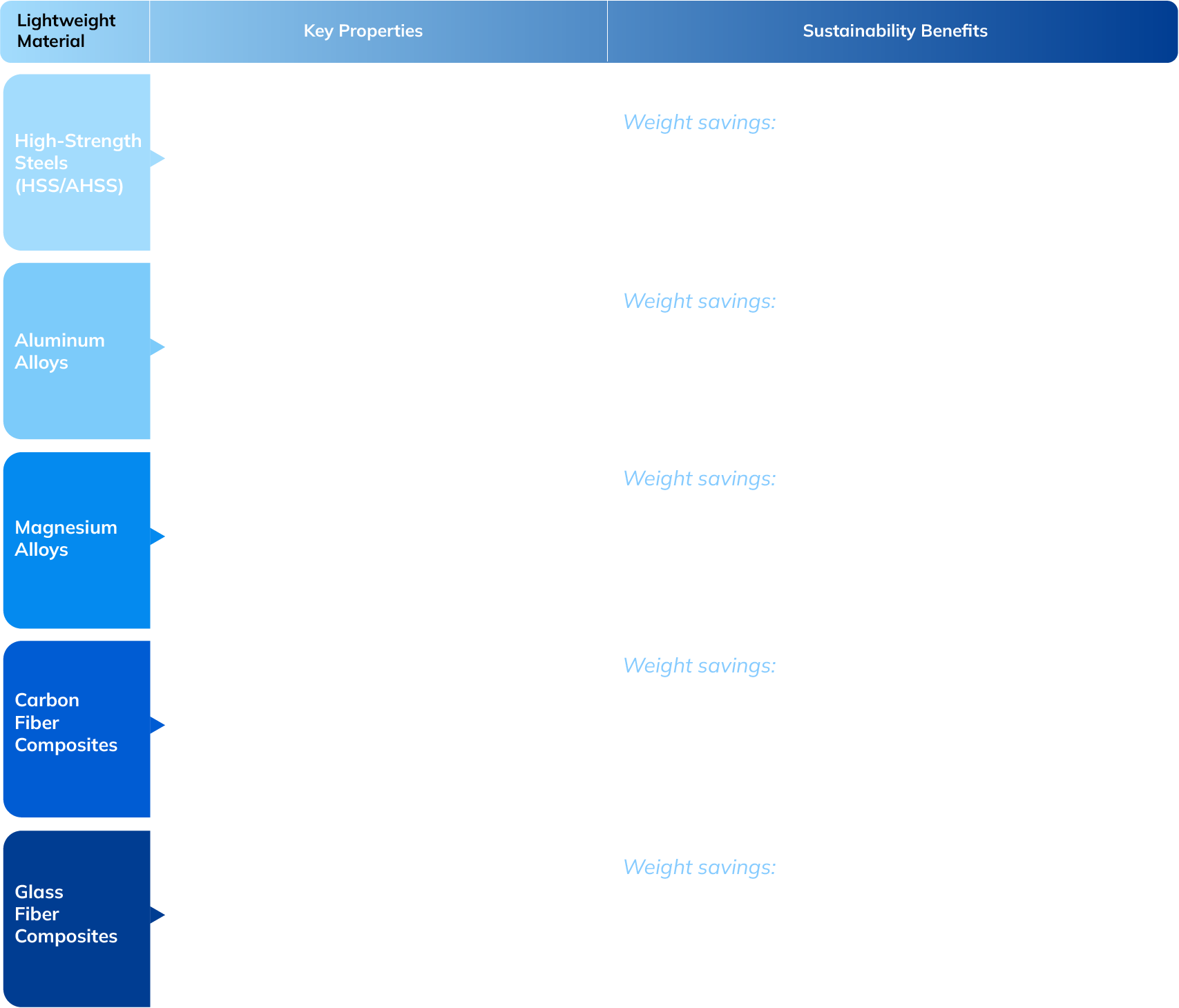
Material innovation is providing a toolkit of options. Engineers now mix and match these materials to hit the sweet spot of strength, weight, cost, and sustainability. For instance, many cars use a multi-material mix: an aluminum hood and trunk (for lightness and rust-proofing), a high-strength steel safety cage (for crash protection), and maybe some composite panels or brackets. Even titanium finds niche uses (like titanium exhaust systems) to cut a few more kilos where cost can be justified. And inside the cabin, swapping out glass for polycarbonate windows or using magnesium in seat frames are clever tricks to save weight without consumers even noticing a difference.
Critically, these lightweight materials are being developed with sustainability in mind. The recyclability of metals like aluminum and steel is a big plus – automakers routinely recycle scrap, and end-of-life vehicles can yield materials for new cars. For composites, which historically were hard to recycle, the industry is innovating recycling processes for carbon fiber and using bio-based components to ensure lightweighting doesn’t come at the cost of landfill waste. Research is ongoing to enable cost-effective reuse of carbon fibers and to design composite parts that can be more easily disassembled or repurposed
Real-World Applications and Trends
What does lightweighting look like in practice across the mobility ecosystem? Let’s look at a few domains:
-
Passenger Cars & EVs: Automakers have been aggressively pursuing lightweight designs to meet fuel economy and emissions standards. A landmark example was a leading OEM’s decision to build the truck body out of aluminum, shedding about 700 lbs (≈320 kg) from the vehicle. This not only improved fuel efficiency but also showed that a lighter truck could maintain tough performance and earn a 5-star safety rating. Today, nearly every manufacturer uses advanced high-strength steel (AHSS) in the chassis and body – for instance, leading PV OEMs incorporate AHSS in frames to maintain safety while trimming weight. Luxury and performance cars often push further- one electric vehicle was built around a carbon fiber passenger cell to offset battery weight, and many sports cars feature carbon fiber roofs, hoods, or driveshafts for weight reduction. Electric vehicles deserve special mention; their heavy batteries drive a need for lighter everything else. That’s why you see EV designs with features like aluminum-intensive bodies (to compensate for a battery pack) and even composite leaf springs or suspension components in some models. The payoff is tangible – lighter EVs go farther per charge. Every kilogram saved is precious; one supplier survey noted automakers view aluminum as an enabler to “extend range while maintaining safety” in EVs.
-
Commercial Vehicles (Trucks & Buses): In the heavy vehicle arena, lightweighting plays a dual role: improving efficiency and increasing payload. A lighter truck can haul more goods for the same total weight limit, which means fewer trips (thus lower total emissions) for a given amount of cargo. Fleet operators and bus companies are adopting components like aluminum wheels and suspension parts, composite trailer panels, and even swapping entire truck frames from steel to lighter alloys. For example, companies have achieved 100–200 kg weight reductions in truck assemblies by replacing iron and steel components with aluminum. Over long distances, those savings add up: a lighter truck uses less fuel climbing hills and accelerating. This helps meet the tightening regulations for freight emissions. There’s also an interesting synergy with clean propulsion – battery-electric or hydrogen trucks weigh significantly more due to batteries or tanks, so using lightweight materials in the cab and chassis offsets that extra mass, preserving payload capacity. Bus manufacturers are likewise using composite bodies and aluminum frames to extend the range of electric buses and reduce component wear. And beyond fuel/emissions, there are operational perks: lighter vehicles often experience less tire and brake wear and can have lower maintenance costs, since there’s less strain on parts.
The Road Ahead: Lighter, Greener, Better
From the earliest days of the automobile, engineers knew that excess weight was a problem – Henry Ford even famously experimented with soybean-based plastic panels for cars in the 1940s to save weight. Today, we have an arsenal of far more advanced solutions to achieve that goal. And the need is more urgent than ever: climate change is driving us to cut emissions, and consumers expect sustainable yet high-performing vehicles. Material innovation is where these goals meet. By using the right materials in the right places, tomorrow’s vehicles, irrespective of whether on roads or in the sky, will be more energy-efficient, emit less CO₂, and even perform better than their heavier predecessors.
It’s also worth noting that lightweighting is part of a bigger sustainability picture. When vehicles are lighter, not only do they consume less energy, but they can also allow smaller engines or batteries, reducing raw material usage. And when those lightweight materials are chosen smartly, we also consider their sourcing and end-of-life. For example, using recycled aluminum or bio-based composites can cut down the embedded carbon footprint of manufacturing. The industry is moving toward a holistic view: maximizing efficiency in use and minimizing environmental impact from cradle to grave.
At Hinduja Tech, we’re passionate about these developments because they align with our vision of transformative, sustainable mobility solutions. Lightweighting isn’t just an engineering tweak – it’s a strategic lever for companies (and entire countries) to meet climate targets without compromising on mobility needs. We strive to keep pushing the envelope, whether it’s adopting the latest material breakthroughs or integrating design and simulation tools to optimize every gram.
In conclusion
Material innovation for lightweighting is driving a virtuous cycle: lighter vehicles -> lower emissions -> a cleaner planet, all while delivering the performance and range that consumers and operators expect. It’s an exciting time to be in the mobility industry, with a blend of materials science and automotive engineering coming together to reinvent transportation.
If you found these insights interesting and want to learn more about how we at Hinduja Tech are enabling sustainable mobility, I invite you to visit our website. Come see how our expertise and solutions are helping to shape the next generation of lighter, greener vehicles. Together, let’s drive the future of mobility toward greater sustainability; one lightweight material at a time.

About Author

Admin
Subscribe to Email Updates
FOLLOW US ON
LinkedIn @Hinduja Tech Limited
Categories
- Body Engineering (5)
- Digital Services (8)
- Electric & Future Mobility (10)
- Product Engineering Services (3)
- RelAI (1)
- SAP (3)
- Thermal Management (1)
- Commercial Vehicle (2)
- Industrial simulation (3)
- Supply chain engineering (1)
- Ergonomics (1)
- Human simulation (1)
- Automotive (4)
- Manufacturing (3)
- General (1)
- Sustainable (8)
- Engineering (13)
- Innovation (2)
- Electronics (1)
- CAE (6)
- Digital Technology (1)
- Supply Chain Management (4)
- vehicle electronics & software (5)
- vehicle engineering (2)
- Mobility (5)