


Offset Frontal Crash Impact Analysis: Enhancing Safety Through Advanced Structural Evaluation
by Jabastin Charles.
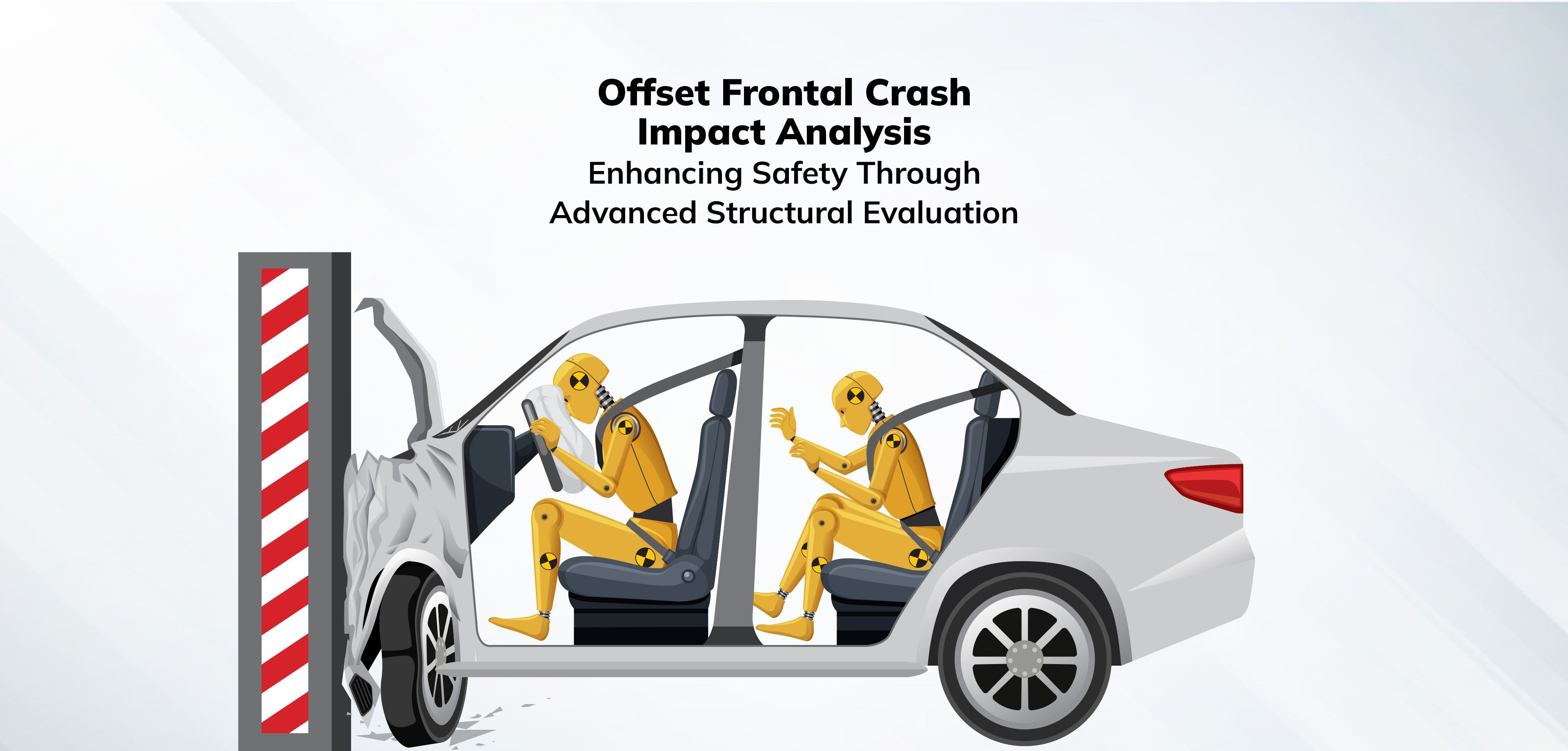
In the pursuit of the "five-star" safety rating, automotive OEMs and Tier 1 suppliers face a challenging engineering paradox: how to reduce vehicle weight for efficiency while increasing structural rigidity for survival. While full-width frontal tests were once the gold standard, real-world data reveals a grimmer reality. Most fatal collisions aren't head-on collisions; they are offset impacts, where only a fraction of the vehicle’s front width absorbs the entire kinetic energy of the crash.
The pain points for modern engineering teams are clear. Designing for asymmetric loading requires a delicate balance of material science and geometry. Failure to manage these concentrated forces leads to catastrophic firewall intrusion, steering column displacement, and compromised "survival cells." Furthermore, the cost of physical prototyping is skyrocketing, and late-stage design failures can set a program back by millions of dollars.
This is where Hinduja Tech’s expertise in offset frontal crash analysis provides a critical advantage, effectively bridging the gap between theoretical design and real-world crash dynamics.
The Engineering Challenge: Managing Asymmetric Energy
In an offset frontal crash, typically impacting just 40% of the vehicle’s width against a deformable barrier, the energy is not distributed evenly across the engine bay. Instead, it is concentrated on one side, forcing the longitudinal members, A-pillars, and sills to work in isolation.
The primary challenge is preventing the engine and transmission from being pushed into the cabin. Engineers must design "load paths" that divert energy away from the occupants and into the floor structure and opposite side of the vehicle. Without precise Finite Element Analysis (FEA), predicting how these asymmetric forces cause vehicle rotation or structural tearing is nearly impossible.
Solution: A Data-Driven Approach to Structural Integrity
At Hinduja Tech, we go beyond basic simulations. Our approach to offset frontal crash analysis for passenger cars focuses on the high-fidelity correlation between virtual models and real-world models.
1. Pre-processing: High-Fidelity FE Model Development We begin by developing a comprehensive Global Finite Element Model (GFEM). This isn't just a shell; it incorporates every critical structural element from Advanced High-Strength Steels (AHSS) to localized weld points and adhesives.
2. Simulation: Baseline vs. Iterative Optimization We initiate the process with a baseline crash simulation to identify "hot spots" where the structure buckles or allows excessive intrusion. Using industry-leading solvers like LS-DYNA, we ensure that material strain rates and deformation patterns are captured with surgical precision.
- Baseline Model: Establishes the current safety threshold.
- Extended Crash Space Iteration: We then virtually "re-engineer" the front-end packaging. By extending or reinforcing specific load paths, we can optimize the crumple zone to absorb higher energy before the force reaches the A-pillar.
3. Deep-Dive Analysis: Intrusion and Pulse Studies Our engineers conduct dedicated intrusion studies, focusing on:
- The Pedal Box and Toe Board: Ensuring the driver’s lower limbs are protected.
- Steering Column Movement: Verifying that the airbag remains in the optimal deployment position.
- Deceleration Pulses: Analyzing the "crash pulse" to ensure that the restraint systems (seatbelts and airbags) can work effectively within the designed time window.
4. Global Regulatory Alignment (NCAP & IIHS) For global companies, safety is a moving target. Our analysis helps OEMs align with international standards, including FMVSS, Euro NCAP, and Bharat NCAP. By simulating these specific protocols virtually, we ensure that vehicles are born compliant, significantly reducing the time-to-market for global platforms.
Quantifiable Outcomes for OEMs and Engineers
By integrating Hinduja Tech’s virtual testing into the R&D cycle, manufacturers achieve:
- Drastic Reduction in Physical Prototypes: Virtual iterations allow for "failing fast" and fixing early, saving millions in hardware costs.
- Optimized Material Packaging: We help identify where heavy reinforcements are unnecessary and where high-strength materials are vital, contributing to overall vehicle light-weighting.
- Enhanced Brand Reputation: In a market where safety is a top consumer priority, delivering a vehicle that excels in offset impact tests is a significant competitive differentiator.
Engineering the Future of Mobility
The transition to electric vehicles (EVs) adds a new layer of complexity to crash analysis, as battery enclosures must remain undamaged during an offset impact. Hinduja Tech is at the forefront of this evolution, empowering engineers and OEMs to transcend basic regulatory compliance.
Through advanced simulation and deep domain expertise, we don't just predict how a vehicle will crash; we engineer how it will protect.

About Author

Jabastin Charles
Subscribe to Email Updates
FOLLOW US ON
LinkedIn @Hinduja Tech Limited
Categories
- Body Engineering (7)
- Digital Services (8)
- Electric & Future Mobility (10)
- Product Engineering Services (3)
- RelAI (1)
- SAP (3)
- Thermal Management (2)
- Commercial Vehicle (2)
- Industrial simulation (3)
- Supply chain engineering (1)
- Ergonomics (1)
- Human simulation (1)
- Automotive (4)
- Manufacturing (3)
- General (1)
- Sustainable (8)
- Engineering (13)
- Innovation (2)
- Electronics (1)
- CAE (7)
- Digital Technology (1)
- Supply Chain Management (4)
- vehicle electronics & software (6)
- vehicle engineering (2)
- Mobility (5)