


Why Leading OEMs Design Automotive BIW Lines Digitally First
by Admin.
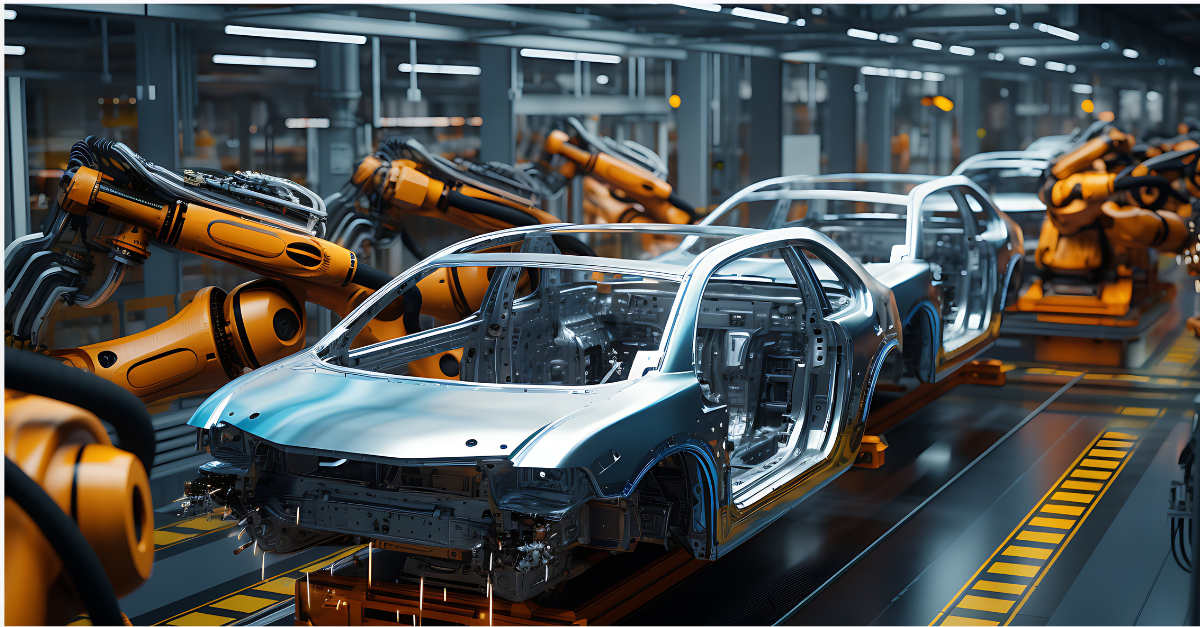
A global automaker is weeks away from the most important moment in its programme calendar: the first vehicle body rolling off a brand-new production line. The plant is gleaming, the robots are in place, and the investment runs into hundreds of millions of dollars. And then the bodies come out wrong. A weld sequence is off. A robot arm clips a fixture. A critical geometry check fails. The launch slips. Every single day of delay costs the OEM a small fortune.
This scenario, once painfully common in the automotive industry, is not a story of bad engineers. It is a story of engineering in the wrong sequence: building first, discovering problems second. Today, the world's leading OEMs have flipped this equation entirely. Before a single steel panel is stamped, before one robot is bolted to the shop floor, the Body in White line, the most complex, capital-intensive assembly operation in automotive manufacturing, is engineered, simulated, validated, and virtually commissioned in the digital world first.
The most expensive place to debug a BIW line is the shop floor. The cheapest place is a digital twin, and the gap between the two is measured in months and millions.
The Staggering Complexity and Cost of a BIW Line
The Body in White is the skeletal structure of a vehicle; it is the bare metal shell before paint, powertrain, trim, or glazing are applied. It is assembled from hundreds of individual stampings, joined by thousands of welds, in a sequence choreographed across dozens of stations. To produce it at automotive quality and speed requires one of the most precise manufacturing environments on earth.
The numbers give a sense of the scale. A modern BIW line at a high-volume OEM typically integrates 400 to 600 six-axis robots, operating across gate stages such as underbody, side frame, roof, respot, and final geometry. Each robot executes 3,000 to 4,500 spot welds per shift, with a station cycle time of just 55 to 65 seconds on a 60-jobs-per-hour line. Automotive body and chassis assembly accounted for approximately 38 to 42 percent of all new industrial robot installations globally in 2024–2025, according to IFR World Robotics data. This is the single largest category of robot deployment in the world.
And the capital commitment matches that intensity. The average investment per automotive manufacturing project rose 24 per cent in inflation-adjusted terms between 2015 and 2024, with billion-dollar mega-projects now accounting for nearly half of all global automotive capital expenditure. A single minute of production downtime in automotive assembly can cost a major OEM more than USD 160,000. Getting the BIW line wrong even once is not an engineering inconvenience. It is a financial event.
The Old Way: Debug on the Shop Floor
For decades, automotive BIW launches followed a sequential logic: design the product, design the tooling, build the line, and then inevitably spend weeks or months discovering and correcting problems on the shop floor. Robots reached conflicts were found only when arms collided with fixtures. Cycle time overruns were discovered only when the line ran at full speed for the first time. PLC logic errors were debugged on live equipment, which stopped production, burned engineering hours, and compressed programme milestones.
This approach had a name that engineers used quietly: "debug on the floor." It was expensive, slow, and, perhaps most damaging, it shifted the cost of engineering iteration from the computer screen to the production plant, where every change requires physical modifications to tools, fixtures, and robot programs. The financial and schedule consequences were severe. And yet, for a long time, there was no alternative.
That alternative now exists. It is the digital BIW line, and it is redefining what vehicle programme launches look like.
BIW Line Simulation: Engineering in the Digital World First
Modern BIW line simulation platforms, including Siemens Tecnomatix Process Simulate, Dassault Systèmes DELMIA, and ABB RobotStudio, allow engineers to construct a complete, high-fidelity digital replica of the entire body shop before a single piece of physical hardware is installed. Every robot, fixture, conveyor, transfer system, and welding gun is modelled with geometric and kinematic precision. The result is a virtual environment where every aspect of the line's behaviour can be tested, iterated, and validated digitally.
What does this make possible? The evidence is compelling:
- 98% of production effort done digitally: In a documented automotive BIW virtual commissioning project using Tecnomatix Process Simulate, a leading luxury automotive manufacturer's system integrator completed 98% of all production engineering work within the simulation, before any physical installation began, dramatically reducing the costs and time required to commission the new production line.
- Up to 60% reduction in commissioning time: Manufacturers using DELMIA Virtual Commissioning have achieved up to 60% reductions in physical commissioning time, enabling faster production ramp-up and greater launch confidence.
- 30% reduction in on-site commissioning time and 20% reduction in overall commissioning costs: Estun Automation, a leading robotics manufacturer, achieved these results using Siemens Tecnomatix Process Simulate for virtual debugging of robot programs and PLC logic before physical deployment.
- 98% simulation accuracy: Tecnomatix provides a compensation alignment capability delivering accuracy as high as 98% in BIW welding line simulation, thereby directly reducing the amount of rework required on the shop floor after physical installation.
The principle is straightforward: BIW line simulation transforms the discovery of errors from a physical event, which costs time, money, and schedule, into a digital event, which costs only compute cycles and engineer hours.
The BIW Line Digital Twin: From Commissioning to Operations
BIW line simulation is the engineering phase. The BIW line digital twin is what comes next, and it is arguably even more powerful.
While simulation is used primarily to validate and commission a line before it exists physically, a digital twin maintains a real-time, bidirectional synchronisation between the virtual model and the live physical line throughout its operational life. Sensor data from robots, conveyors, welding controllers, and quality systems feeds continuously back into the digital twin, updating it to reflect the actual state of the production environment. This creates an always-current virtual replica of the operating BIW line, enabling a range of capabilities that were previously impossible.
The results in production are striking. A rigorous, peer-reviewed case study published in MDPI Sensors demonstrated that deploying a digital twin on an automotive production line resulted in a 6.01% increase in production line efficiency and an 87.56% improvement in downtime management by enabling predictive maintenance and continuous process optimisation in real time.
At the strategic level, McKinsey research confirms that digital twins in manufacturing cut development times by up to 50%, reduce labour costs by 10%, and deliver 15-30% ROI, typically within the first two years of deployment. The global digital twin market in manufacturing was valued at USD 3.6 billion in 2024 and is projected to reach USD 42.6 billion by 2034, growing at 28.1% CAGR, a rate that reflects how rapidly this technology is becoming a production standard, not a competitive edge.
What 'Digital First' Specifically Unlocks for BIW Lines
Designing a digital BIW line first is not simply a way to catch problems earlier. It unlocks a set of engineering capabilities that are structurally impossible in a physical-first approach:
- Multi-robot synchronisation validation: Simulation platforms allow engineers to validate the coordinated behaviour of hundreds of robots simultaneously, such as testing collision envelopes, cycle time balance, and sequence logic across every station in the line before any robot is physically installed.
- Virtual PLC commissioning: Programmable logic controller code can be written, tested, and debugged entirely within the simulation environment, connected to virtual representations of the physical control architecture. This eliminates the most dangerous and expensive category of shopfloor rework, wherein logic errors that only manifest when the line runs at speed.
- Material flow and ergonomic optimisation: Plant simulation tools model material handling, logistics, and operator workflows, enabling the identification of bottlenecks, non-value-added travel, and ergonomic risks in the digital environment, where corrective redesign costs a fraction of what it would cost on the shop floor.
- Variant and platform flexibility planning: As OEMs accelerate platform-sharing strategies, the digital BIW line can be rapidly reconfigured to simulate the introduction of new variants; testing whether an existing line can absorb a new body style without disrupting current production, before a single tooling change is committed to steel.
- Operator training before SOP: Unlike classic commissioning, virtual line environments allow operators and maintenance technicians to begin training against a fully functional digital model of their equipment, sometimes weeks before physical commissioning begins, compressing the learning curve and accelerating production ramp-up.
Hinduja Tech: Engineering the Digital BIW Line
At Hinduja Tech, our Manufacturing Engineering team brings precisely this digital-first philosophy to every BIW line engagement. With over 100 years of collective manufacturing experience embedded in our organisation, we combine deep domain expertise with the latest digital manufacturing tools to deliver results that software-led or hardware-led organisations alone cannot match.
Our service portfolio for BIW and production line engineering spans the full programme lifecycle:
- Process Engineering: Manufacturing process definition, station layout, weld sequence planning, and cycle time analysis from the earliest programme stage.
- Virtual Factory Simulation: Full-line simulation using tools including Siemens Tecnomatix, Dassault DELMIA, Visual Components, and Quest, validating robot reachability, collision clearance, cycle time balance, and material flow before physical commitment.
- Industrial Engineering: Operator utilisation, ergonomic analysis, line balance, and non-value-added activity elimination applied digitally, not reactively on the shop floor.
- Tool Design: Fixture and tooling design developed concurrently with the process simulation, ensuring that what is validated digitally can be built and operated precisely as engineered.
- On-site Commissioning to SOP: Where physical commissioning is required, our experienced team provides on-site support through line sign-off, along with digital twins providing the baseline against which physical performance is measured and tuned.
The evidence of value delivery is concrete. For a leading commercial vehicle manufacturer, Hinduja Tech's simulation-driven approach boosted operator utilisation by 10%, generating several thousand dollars in annual savings. Across multiple programmes, plant simulation improved production capacity by 8-12% without adding a single robot or building a new station. These gains were discovered and implemented digitally before incurring the costs of the physical world.
Hinduja Tech also applies its Frugal EngiNEARing paradigm to manufacturing, wherein delivering solutions engineered to the right cost, not merely the lowest cost, through zero-based process design and systematic elimination of waste at the planning stage. With a 700+ supplier network and proven experience across greenfield, brownfield, and NPI programmes for 100+ global OEMs and Tier-1 suppliers, we bring both the engineering depth and the programme experience that BIW line digitalisation demands.
The Era of the Digital-First BIW Line Has Already Begun
A vehicle body is not assembled in a vacuum. It is the product of thousands of decisions made weeks, months, and years before the first panel is stamped, decisions about robot placement, weld sequences, fixture geometry, conveyor logic, and operator workflow. When those decisions are made physically first, their consequences are discovered physically too, at the worst possible time: during commissioning, during launch, during ramp-up.
When those decisions are made digitally first within a rigorously constructed BIW line simulation and continuously refined through a live BIW line digital twin, their consequences are discovered cheaply, quickly, and safely. Errors become design iterations. Launch delays become avoided risks. And the shop floor becomes what it should be: a place of execution, not experimentation.
The world's leading OEMs have already understood this. The question for every remaining programme is not whether to design the Body in White line digitally first, but how quickly to build the engineering capability to do so, and with whom to partner to make it real.
At Hinduja Tech, we engineer that digital future: one simulated station, one validated sequence, and one successful launch at a time.

About Author

Admin
Subscribe to Email Updates
FOLLOW US ON
LinkedIn @Hinduja Tech Limited
Categories
- Body Engineering (5)
- Digital Services (8)
- Electric & Future Mobility (10)
- Product Engineering Services (3)
- RelAI (1)
- SAP (3)
- Thermal Management (1)
- Commercial Vehicle (2)
- Industrial simulation (3)
- Supply chain engineering (1)
- Ergonomics (1)
- Human simulation (1)
- Automotive (4)
- Manufacturing (3)
- General (1)
- Sustainable (8)
- Engineering (13)
- Innovation (2)
- Electronics (1)
- CAE (6)
- Digital Technology (1)
- Supply Chain Management (4)
- vehicle electronics & software (5)
- vehicle engineering (2)
- Mobility (5)