


Automotive Layout Engineering: Streamlining Manufacturing for Faster Growth
by Nithyanand S.
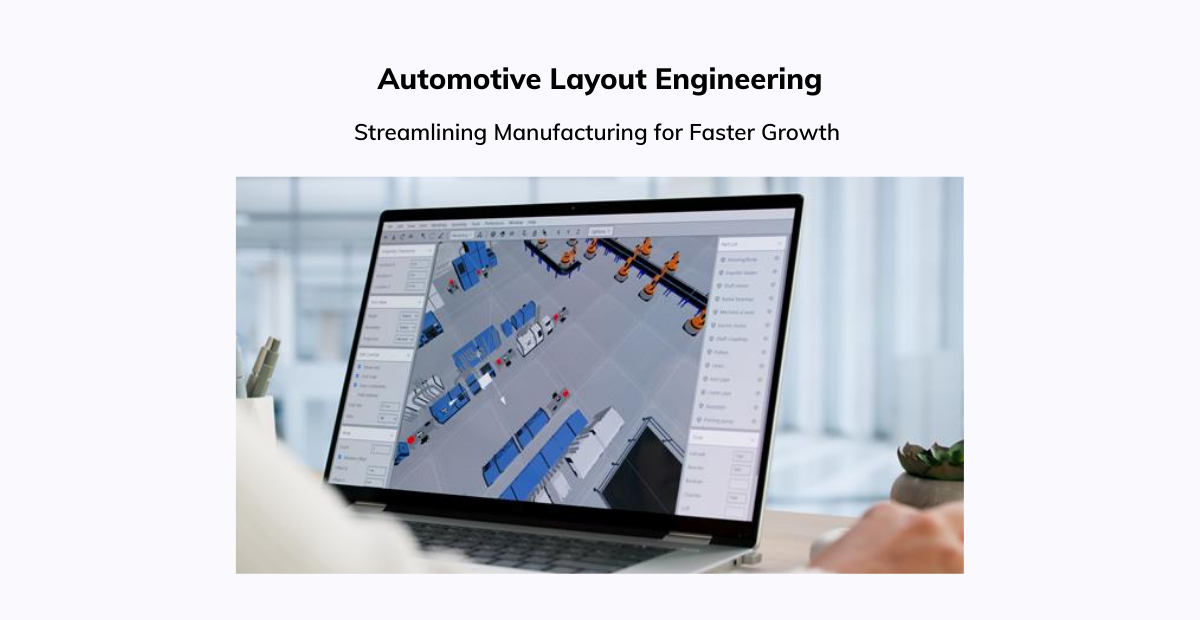
Imagine the heartbeat of a modern manufacturing plant, not just a place where products are built, but a space where process efficiency, material movement, and data-driven optimization work in perfect harmony.
In the high-stakes world of automotive manufacturing, every centimetre of floor space counts and every second of cycle time affects your profit margin.
Layout engineering is the silent foundation on which factories evolve, adapt, and outperform in a world defined by speed, quality, and cost control. Yet, many OEMs and Tier-1 suppliers are attempting to meet tomorrow's production targets using yesterday's static, outdated floor plans. When your layout is rigid, your business cannot be agile.
In this blog, we explore why traditional layouts are failing modern demands and how Hinduja Tech's advanced layout engineering solutions are turning shop floors into engines of faster growth.
The Barriers to Growth: Four Layout Challenges Holding You Back
Before a plant can be optimized, we must identify the hidden friction points that drain resources.
Most automotive leaders face these four critical challenges:
- The "Silent" Cost of Movement: Inefficient material flow often goes unnoticed until it’s too late. Parts traveling unnecessary distances lead to "wasted motion," increased forklift traffic, and higher logistics costs.
- Bottleneck Anxiety: Without data-backed modeling, identifying where production will "choke" is guesswork. Managers often find out a station is too slow only after the line is live and targets are being missed.
- Brownfield Constraints: Fitting 2026 technology into a 1990s floor plan creates ergonomic risks and safety hazards that can lead to worker fatigue or regulatory non-compliance.
- Slow Time-to-Market: Traditional layout planning is slow. In a fast-paced market, the inability to quickly model "what-if" scenarios for new product launches can put you months behind the competition.
The Solution:
Development of Greenfield Layout or Update of Existing Layout
Whether you are envisioning a state-of-the-art greenfield facility or revitalizing an existing brownfield site, your factory layout is your most critical operational asset. At Hinduja Tech, we bridge the gap between architectural vision and manufacturing reality with data-driven insights of your plant.
The layout planning phase typically includes the following to avoid bottlenecks and inefficient material flow, aimed at achieving the line's throughput.
- Facility analysis
- Space planning
- Process flow analysis
- Workstation design
- Material handling system
- Support facilities and infrastructure
- Safety and compliance
- Simulation and evaluation
- Implementation and continuous improvement
3D Plant Layout Modeling
It is hard to truly visualize the space, identify potential conflicts, or understand the flow of materials from a flat, static 2D layout. Insufficient data from the 2D drawings can lead to unexpected issues during installation, costly rework, and a missed opportunity to optimize every square foot of the plant.
This is where 3D plant layout modeling comes in. It helps us identify bottlenecks and interference and optimize flow and space.
Developed using software such as CATIA V5/NX/SOLIDWORKS, the 3D plant layout provides stakeholders with a clear picture of the process flow, spatial constraints, and equipment interdependencies. The developed 3D models empower cross-functional teams to implement unexpected changes, review and analyze ergonomics, and easily validate service accessibility. The model can also be used as input for simulations to evaluate multiple scenarios and spot potential issues before they reach the factory floor.
Validation of the Designed Layout
We validate and optimize the designed layout of the manufacturing system using simulation tools, such as Tecnomatix, to minimize material-handling distances and improve flow.
The process includes:
- Analyzing and optimizing the routing and sequencing of materials within the system to reduce transportation time and costs.
- Assessing the impact of different production strategies, such as batch processing or continuous flow, to improve material flow and productivity.
- Evaluating the utilization and capacity of machines and workstations in the production process.
- Identifying and resolving bottlenecks or congestion points that hinder smooth material flow.
Based on the simulation feedback, we update the layout to achieve the line's throughput and optimize material flow, storage area, and line-side storage area.
Values We Deliver
- Clear Process Visualization: Business leaders and frontline teams gain an instantly understandable blueprint of the process flow.
- Immediate Material Flow Insights: Efficiency improves as teams readily see how materials move, identifying opportunities to cut waste and reduce cycle times.
- Future-Proof Scalability: Modular layout designs allow you to add new lines or upgrade technology with minimal disruption to existing operations.
Choose Hinduja Tech for Faster Decisions and Smoother Operations
With Hinduja Tech, clients experience faster turnaround on layout changes and a clearer, smarter approach to shop floor management. Our expertise with AutoCAD, SOLIDWORKS, and CATIA V5 ensures best-in-class accuracy and adaptability, while our data-driven process guarantees that every modification aligns with bigger business goals.
The results are easy to see: improved throughput, reduced errors, and a platform for continuous improvement. Businesses gain enhanced process visibility, optimized logistics, and the agility to react to demands, such as launching new products or scaling up existing operations.
Build Tomorrow’s Factory Today
In a world where manufacturing success is measured in speed and quality, the right layout engineering partner makes all the difference. Hinduja Tech’s combination of deep domain expertise, advanced tools, and a relentless focus on process optimization positions clients for sustainable growth.
Ready to transform your plant into a model of operational excellence? Discover how our layout engineering services can drive clarity, speed, and value, connecting business vision to manufacturing reality.
Email us at info@hindujatech.com to learn more about our layout engineering services

About Author

Nithyanand S
Subscribe to Email Updates
FOLLOW US ON
LinkedIn @Hinduja Tech Limited
Categories
- Body Engineering (5)
- Digital Services (8)
- Electric & Future Mobility (10)
- Product Engineering Services (3)
- RelAI (1)
- SAP (3)
- Thermal Management (1)
- Commercial Vehicle (2)
- Industrial simulation (3)
- Supply chain engineering (1)
- Ergonomics (1)
- Human simulation (1)
- Automotive (4)
- Manufacturing (3)
- General (1)
- Sustainable (8)
- Engineering (13)
- Innovation (2)
- Electronics (1)
- CAE (6)
- Digital Technology (1)
- Supply Chain Management (4)
- vehicle electronics & software (5)
- vehicle engineering (2)
- Mobility (5)