


How the Vehicle Control Unit Is Evolving into the Brain of the Software-Defined Vehicle
by Mahendra Pardeshi.
The Shift in Automotive Architecture
Think about the last time your phone received an overnight software update, and you woke up with new features. Now imagine that happening to your car; new driving modes unlocked, battery range improved, safety algorithms sharpened, all without visiting a service centre. That is not a future promise. For a growing number of vehicles rolling off production lines today, it is already a reality.
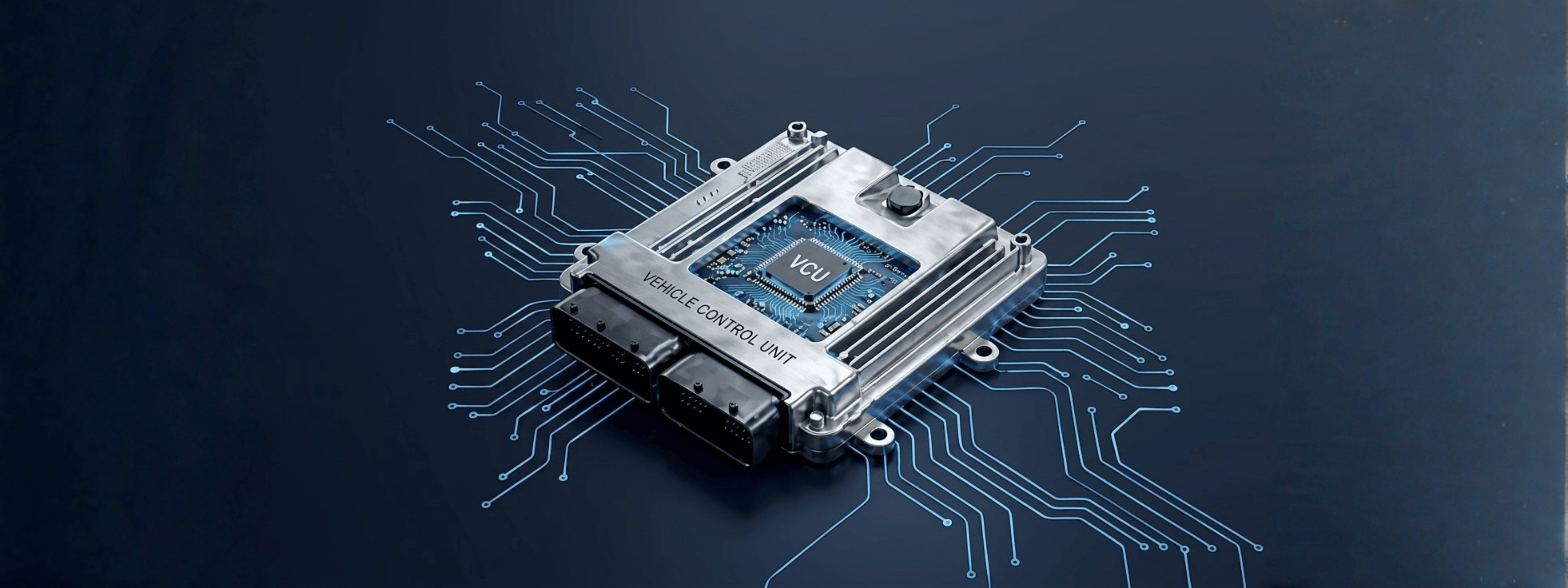
At the centre of this transformation sits a component that has existed in vehicles for decades but is now being asked to do something fundamentally different: the Vehicle Control Unit, or VCU. Once a modest embedded controller managing torque and energy flows in a hybrid or electric vehicle, the VCU in the software-defined vehicle is evolving into the centralised intelligence hub of the entire machine; it is rapidly becoming the brain that thinks, decides, learns, and adapts.
The data tells a compelling story. The global vehicle control unit market was valued at USD 7.51 billion in 2024 and is projected to reach USD 21.86 billion by 2030, growing at a CAGR of 19.49%. Underpinning this growth is an even larger transformation: the global software-defined vehicle market, valued at USD 49.3 billion in 2024, is expanding at 25.2% per year through 2034. These are not incremental improvements. They are signals of an architectural revolution underway in the automotive industry.
Traditional VCU vs Modern Intelligent VCU
To understand how far the vehicle control unit has come, it helps to picture what a traditional vehicle looked like underneath. A conventional premium car houses between 70 and 150 individual electronic control units (ECUs), each with a dedicated, purpose-built processor managing a single function: engine management, Anti-lock Braking System (ABS), airbag deployment, climate control, and infotainment. These ECUs were wired together through a convoluted harness that, in some premium vehicles, weighed more than 50 kg. Each unit ran its own proprietary software, in isolation, with no simple path to update or upgrade.
This architecture was robust for its era. But it was built for a world of mechanical complexity, not software complexity. As vehicles began to integrate ADAS, electrification, V2X connectivity, and over-the-air updates, the distributed ECU in electric-vehicle architectures began to buckle under the weight of its own fragmentation. Integration costs soared. Software updates required physical visits and every new feature added to an already overcrowded wiring architecture.
The modern intelligent VCU resolves this by consolidation. Rather than 100 discrete automotive ECUs each running a separate function, today's domain-controller architectures concentrate vehicle intelligence into a handful of powerful, high-performance processing nodes. Rivian's R2 platform makes this tangible: where a traditional premium vehicle deploys 40 to 150 ECUs, the R2 uses just 7 zonal controllers and, in doing so, removes 1.6 miles of wiring from the vehicle. The result is a lighter, more reliable, more software-updatable machine.

Why VCU Software Complexity Is Increasing
A modern premium vehicle already contains more than 100 million lines of code, far more than a fighter jet or a commercial aircraft. And that number is set to grow: a fully autonomous Level 5 vehicle is expected to require up to one billion lines of code. The electronic control unit of the SDV era must manage all of this not as a fixed, factory-configured system, but as a living, updatable software platform.
Three forces are driving this exponential rise in VCU software-defined vehicle complexity:
- Electrification: Every EV requires real-time coordination between battery management, motor control, regenerative braking, thermal management, and charging, all in milliseconds. Modern VCU now manages 800V high-voltage architectures, requiring millisecond-level synchronisation between thermal management and power delivery to prevent overheating during rapid charging. This is an entirely new category of computational demand that a traditional ECU in an electric vehicle cannot fulfil.
- ADAS and autonomy: Nearly 4.5 million vehicles were equipped with Level 2 and above ADAS systems in 2024, with volumes projected to double by 2026 and beyond as regulators in Europe and North America mandate lane-keeping, automated braking, and driver monitoring. Each of these functions requires sensor fusion, real-time inference, and safety-critical decision-making, all orchestrated by the VCU, which acts as a domain controller.
- Over-the-Air (OTA) updates: The shift to OTA is perhaps the most profound change. A VCU designed for SDV must support secure boot, a hardware root of trust, and a modular software architecture, enabling individual functions to be updated post-production without disrupting safety-critical systems. This capability makes a vehicle behave more like a smartphone, improving throughout its life rather than degrading.
The software productivity gap compounds the challenge. Over the past decade, automotive software complexity has grown roughly fourfold, while development productivity has increased only 1.5-fold. This mismatch is precisely why scalable, standards-based VCU development methodology matters so much.
The Importance of Scalable VCU Software Development
The vehicle control unit of the SDV era cannot be engineered the old way. Point-solution development, such as building bespoke software for each vehicle variant, each market, each model year, is not economically viable at the scale demanded by modern automotive programmes. Scalability is the engineering imperative.
In the era of software-defined vehicles, the VCU is no longer just a controller. It is the platform on which the vehicle's entire value proposition is built and continuously rebuilt over its lifetime.
Scalable VCU software development rests on four pillars:
- AUTOSAR compliance: AUTOSAR Classic provides a standardised base for safety-critical, real-time automotive ECU functions. AUTOSAR Adaptive, built on POSIX and Linux, enables the high-performance, service-oriented computing that ADAS and connected vehicle features demand. The two platforms running in parallel within a single VCU, managed by a hypervisor, define the modern software stack.
- ISO 26262 functional safety: As the VCU consolidates more safety-critical functions, Automotive Safety Integrity Level (ASIL) compliance must be managed at the system level, not just the component level. Meeting ASIL-D requirements, the highest safety rating across a multi-domain VCU, is an engineering challenge that demands deep expertise in hazard analysis, fault-tolerant design, and verification.
- Model-based and virtual development: Predefined software models in MATLAB/Simulink allow rapid customisation and front-loading of validation. Virtual ECUs (vECUs) enable software testing and integration without physical hardware, compressing development timelines and reducing the cost of late-stage defect discovery. The V-model of concurrent hardware-software-system integration, rather than sequential handoffs, is now the industry standard for programmes that cannot afford delays.
- Cybersecurity by design: ISO/SAE 21434 mandates that cybersecurity is designed into the vehicle architecture from the concept stage and not retrofitted at the end. As the VCU becomes the gateway through which OTA updates, V2X communications, and cloud connectivity flow, its security posture becomes a critical product attribute rather than a compliance checkbox.
The Road Ahead - Intelligence at the Centre
The trajectory of the vehicle control unit points toward one destination: a single, centralised compute platform managing every domain of the vehicle, be it the powertrain, chassis, ADAS, infotainment, thermal, cybersecurity, all in real time, with the ability to update any function over the air, at any point in the vehicle's life. This is not science fiction. It is the architecture that Tesla has deployed at scale, that Rivian has demonstrated in its R2, and that every major OEM is now racing to replicate.
The market is following the engineering conviction. Over 42 million vehicles globally were expected to ship with at least one form of domain controller or centralised ECU architecture in 2025, up sharply from prior years. The VCU market is projected to reach USD 15.28 billion by 2035 at an 18.9% CAGR, according to recent market intelligence reports.
For the engineers, program managers, and OEM leaders building these vehicles, the VCU's evolution from embedded controller to software platform is the single most consequential architectural decision of the decade. Getting it right, be it in software architecture, safety compliance, cybersecurity, and scalable development methodology, determines whether a vehicle programme delivers a machine that improves over time, or one that is frozen at the moment it leaves the factory.
Engineering the Intelligent VCU: Hinduja Tech's Approach
At Hinduja Tech, our Vehicle Engineering practice is built precisely around the demands this evolution places on program teams. With over 25 years of R&D experience and a dedicated Electronics Lab enabling embedded system development and testing on mule vehicles, we deliver end-to-end VCU software-defined vehicle development across the complete technology stack.
Our capabilities span the full VCU development lifecycle: Systems Engineering and Software Architecture; AUTOSAR Classic and Adaptive platform development; MATLAB/Simulink model-based design and auto-code generation; MIL, SIL, and HIL testing; ISO 26262 functional safety compliance; and ISO/SAE 21434 cybersecurity integration. We follow the proven V-model of agile development, ensuring hardware, software, and system integration proceed concurrently, thereby compressing programme timelines without compromising rigour.
Our track record is concrete: we have delivered projects comprising 200 software modules and 20,000 lines of production-grade code in just 4 to 5 months, for leading global OEMs and Tier-1 suppliers across ADAS, electric powertrains, BMS, body electronics, and power electronics.
The vehicle is becoming a software product. The VCU is becoming its operating system. And the engineering teams that master this transition with rigour, scalability, and speed will define what sustainable mobility looks like for the next generation.

About Author

Mahendra Pardeshi
Subscribe to Email Updates
FOLLOW US ON
LinkedIn @Hinduja Tech Limited
Categories
- Body Engineering (7)
- Digital Services (8)
- Electric & Future Mobility (10)
- Product Engineering Services (3)
- RelAI (1)
- SAP (3)
- Thermal Management (2)
- Commercial Vehicle (2)
- Industrial simulation (3)
- Supply chain engineering (1)
- Ergonomics (1)
- Human simulation (1)
- Automotive (4)
- Manufacturing (3)
- General (1)
- Sustainable (8)
- Engineering (13)
- Innovation (2)
- Electronics (1)
- CAE (7)
- Digital Technology (1)
- Supply Chain Management (4)
- vehicle electronics & software (6)
- vehicle engineering (2)
- Mobility (5)